Fiber Laser Marking Machine
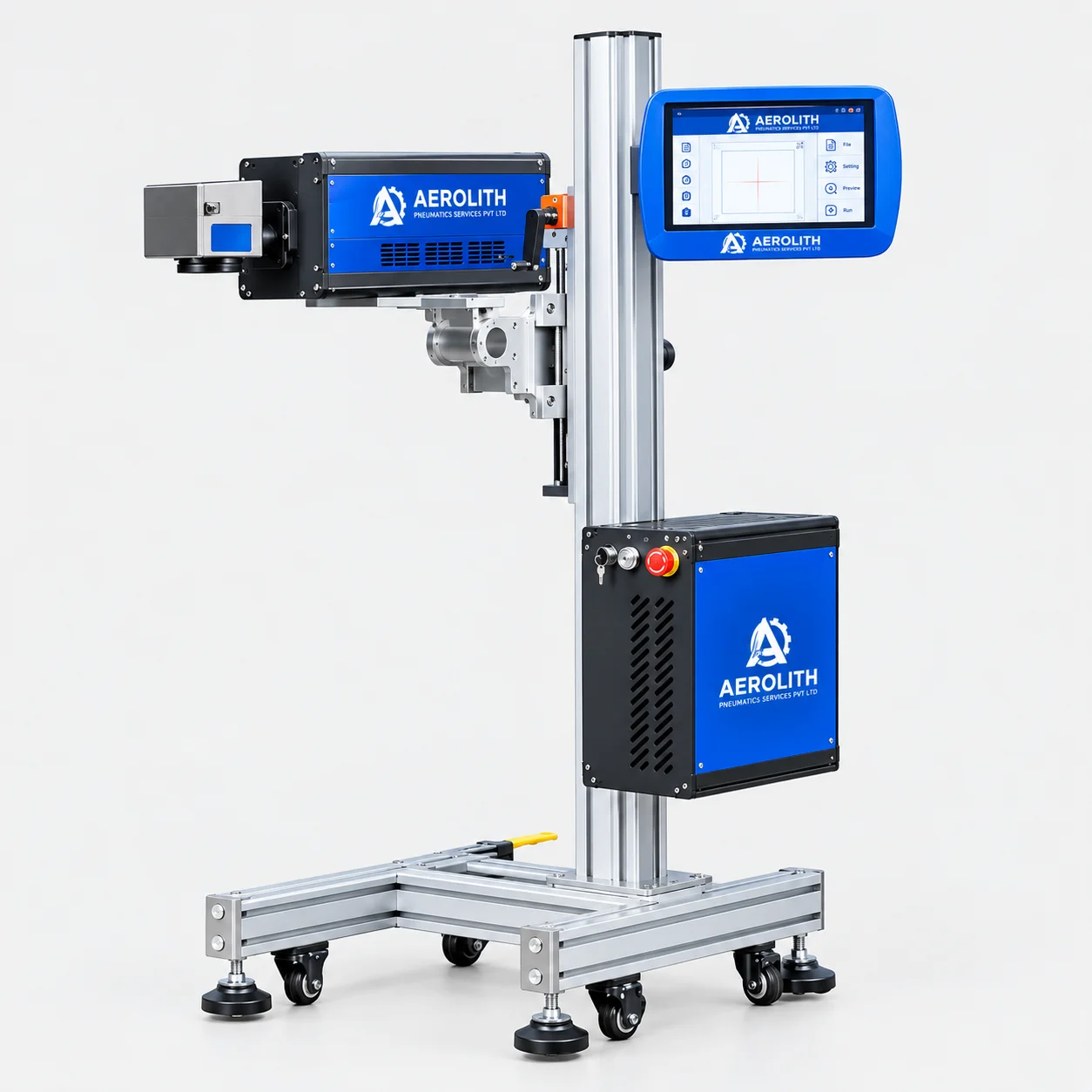
Fiber Laser Marking Machine in Nepal
Fiber laser marking machines for permanent metal marking — stainless steel, aluminium, brass, copper, titanium, and hard engineering plastics. 1,064 nm wavelength with 100,000+ hour fiber source life and zero consumables. AP Compressors (Aerolith Machinery) supplies and services fiber laser systems across Nepal with full installation and operator training.
- Marks all metals — stainless steel, aluminium, brass, copper, titanium
- 100,000+ hour fiber source — lowest lifetime cost of any laser type
Instant factory quotation & 100,000h laser source warranty in Nepal
Fiber laser marking machine specifications
| Laser type | Fiber laser — ytterbium-doped fiber |
| Wavelength | 1,064 nm (near-infrared) |
| Power range | 20W – 100W |
| Marking area | 100×100 mm – 300×300 mm |
| Marking speed | Up to 10,000 mm/s |
| Repeat accuracy | ±0.002 mm |
| Fiber source life | 100,000+ hours |
| Cooling | Air-cooled |
| File formats | AI, DXF, BMP, PLT, CDR, JPG, PNG |
| Best for | Metals, stainless steel, aluminium, hard plastics |
| Service coverage | Nepal nationwide |
Choosing the right fiber laser wattage
20W — Light marking at moderate speed
Suitable for surface annealing, colour marking on stainless steel, and engraving on most metals at moderate production speed. Best for workshops, jewellery, and small-scale part marking.
30W — Standard production choice
The most popular wattage for industrial part marking in Nepal — balances marking speed with cost. Handles serial numbers, barcodes, QR codes, and logos on steel and aluminium at commercial line speeds.
50W — Higher speed production lines
For plants with high daily marking volume needing faster cycle times. 50W also enables deeper engraving on hard materials like tool steel and carbide.
100W — Deep engraving and maximum speed
Used for deep die marking, mould identification, heavy industrial parts, and maximum-speed production lines. AP Compressors recommends 100W only when the application genuinely requires it.
Fiber laser marking applications in Nepal
Auto Components & Engineering Parts
Serial numbers, part codes, manufacturer logos, and compliance marks on engine components, fasteners, brackets, and machined metal parts — permanent, abrasion-resistant.
Jewellery & Precious Metals
Hallmarks, brand logos, carat marks, and custom engravings on gold, silver, platinum, and brass jewellery — Fiber laser delivers fine-detail marks without damaging delicate pieces.
Industrial Tools & Hardware
Model numbers, size codes, batch IDs, and brand logos on hand tools, cutting tools, drill bits, spanners, and industrial hardware — marks survive workshop conditions.
Stainless Steel Products
Product codes, QR traceability, and brand marks on stainless steel utensils, medical instruments, kitchen equipment, and food-grade SS components.
Electrical & Electronics Housings
Rating labels, certifications, serial codes, and brand marks on aluminium and steel electrical enclosures, motor housings, and control panel components.
Mould & Die Identification
Cavity numbers, revision codes, and mould identification marks on steel moulds, press dies, and injection mould inserts — deep, permanent engraving.
Types of marks a fiber laser machine produces
Annealing
Heat-induced colour change on stainless steel — produces black, blue, or gold marks with no material removal. Used for medical instruments and food-grade SS components.
Engraving
Material removal to create recessed marks — deep, tactile, and permanent. Used for part numbers, serial codes, and die identification.
Ablation
Removes a coating or anodised layer to reveal a contrasting base material — common for anodised aluminium panels and coated metals.
Foaming (Plastics)
Creates raised, light-coloured marks on dark plastic — high contrast for product labels and model numbers on ABS and PC housings.
Colour Marking
Controlled oxidation produces a range of colours on steel — used decoratively in jewellery, trophies, and high-value component marking.
Carbonising
Creates dark marks on light-coloured plastics and organic materials — used for product codes on nylon, PTFE, and engineering polymers.
Get a fiber laser marking machine quote for Nepal
Share your material, part size, marking content, and daily production volume — we will recommend the correct wattage and configuration.
Support & Answers
Frequently
Asked Questions
Find answers about our air compressors, air dryers, filters, customized compressed air solutions, installation, and maintenance services.
Reach out to our teamA fiber laser marking machine uses a 1,064 nm infrared wavelength generated through a fiber-optic medium to permanently mark metals and hard plastics. It is the industry standard for stainless steel, aluminium, brass, copper, titanium, carbide, and most engineering plastics — producing deep engravings, surface annealings, or high-contrast colour changes depending on the material and laser settings.
Fiber lasers mark all common engineering metals: stainless steel, mild steel, tool steel, aluminium, anodised aluminium, brass, copper, titanium, chrome, nickel, carbide, and precious metals like gold and silver. They produce permanent marks that withstand abrasion, chemicals, heat, and mechanical wear.
Fiber laser marking machine prices depend on power (20W, 30W, 50W, 100W), scan head quality, field size, and brand. Contact AP Compressors at +977 9806922190 for a quote based on your material and marking speed requirement.
The fiber laser source (gain medium) has a rated life of 100,000+ hours — far exceeding CO2 glass tubes (8,000–12,000 hours) and CO2 RF tubes (20,000–45,000 hours). This makes fiber laser machines extremely cost-effective over the long term with minimal source replacement cost.
Yes. Fiber laser systems are the standard tool for serialisation, part number marking, barcode (Code 128, EAN, UPC), QR code, DataMatrix, and logo engraving on metal components — used in automotive, aerospace, engineering, jewellery, and tool manufacturing industries. Marks are permanent, machine-readable, and tamper-proof.
Higher wattage increases marking speed and allows deeper engraving, but is not always necessary. 20W is sufficient for surface marking on most metals at moderate speed. 30W–50W suits higher-volume production lines needing faster cycle times. 100W is used for deep engraving, heavy-duty production, or extra-hard materials. AP Compressors recommends the correct wattage based on your material thickness and production volume.
Yes. AP Compressors provides full installation, software setup, operator training, and after-sales service for fiber laser marking machines across Nepal. Service is available in Kathmandu, Bhairahawa, Birgunj, Biratnagar, Pokhara, Bharatpur, and surrounding industrial zones.
Yes. Fiber lasers mark hard engineering plastics including ABS, PC, PA (nylon), POM (Delrin), PEEK, and filled/composite polymers effectively. However, for soft plastics, thin films, or heat-sensitive materials, a UV laser is more appropriate. AP Compressors confirms the right laser type for your specific plastic grade before recommending a system.